Pastor, I plan my preaching 12 months out. Here’s the calendar system.

For years I preached week to week, which is a polite way of saying I lived in survival mode — every Monday a blank page, every Saturday night a low-grade panic. Then I learned what the pastors of the healthiest churches I coach all have in common: they plan their preaching 12 to 36 months out. A preaching calendar isn’t a constraint on the Spirit — it’s a weapon for intentional ministry. Here’s how I build mine, in four moves.
Step 1 — Mark the growth windows before you plan a single sermon
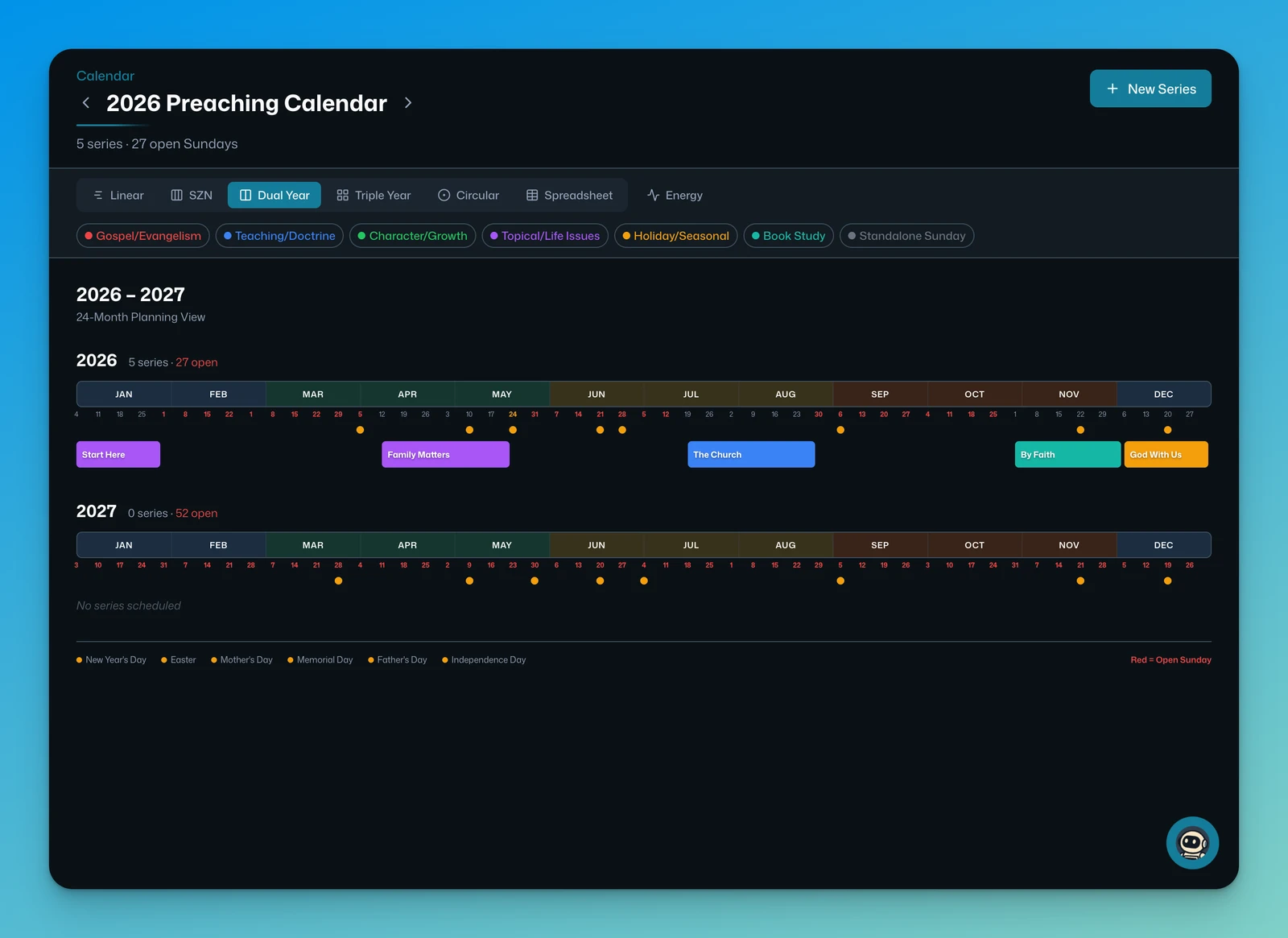
Don’t start with content. Start with the calendar itself. Every church has about four major growth windows a year — the seasons when new people actually show up:
- Easter — the biggest guest weekend of the year, every year
- Back-to-school — late summer, when families reset their rhythms
- Christmas — the second-biggest guest season
- New year — January, when everyone is looking for a fresh start
Print out twelve months and circle those windows first. Everything else gets planned around them. Most pastors do this backwards — they plan the series they’re excited about and let the windows land wherever they land. Which is how churches end up running their weakest content on their highest-attendance weekends.
Step 2 — Put your best series in the windows
Now the strategic move: map your biggest, best series onto those high-attendance seasons. The series with the strongest felt-need hook, the clearest invitation, the most shareable premise — that’s your Easter series, your January series. New people are already coming; your job is to give them a reason to come back.
Then look at the rest of the year with equal honesty. The slower seasons — deep summer, late fall — are where you go deep: the longer expositional series, the harder books, the meat your core actually needs. A 12-month calendar lets you feed both the crowd and the core on purpose, instead of feeding whoever you happened to think of first.
Step 3 — Build each series as a 4–6 week arc, not a pile of sermons
A great series is a growth engine; a mediocre one is just consecutive sermons with matching graphics. The difference is architecture. For each series on the calendar, sketch three things before you write anything:
The arc — four to six weeks, because momentum builds week over week and dies around week seven. The hooks — an individual title and one-sentence hook for every week, so each sermon earns anticipation for the next. The runway — graphics, social posts, and teaser content planned far enough ahead that your church can actually invite people, which is the entire point of putting your best series in a growth window.
You’re not writing the sermons yet. You’re building containers strong enough that people can’t miss what goes in them.
Step 4 — Assign the texts, then bank the margin
Now fill the arcs: assign a passage to every week of the next twelve months. Yes, it will flex — a calendar is a plan, not a prison, and you can always shift when God redirects. But here’s what changes immediately: you now know in July what you’re preaching in November. That’s the margin week-to-week pastors never get to taste.
Margin is the real payoff of the whole system. Illustrations start finding you, because you know where you’re headed. Study can start weeks out instead of days. Your worship leader, your kids team, and your creatives can build with you instead of reacting to you. The calendar doesn’t make preaching mechanical — it makes every single week deeper.
Step 5 — Generate the draft in minutes, then make it yours
The blank twelve-month grid is where most pastors stall, so don’t start blank. The Sermons module in Pastor Center will generate a 12, 24, or 36-month sermon calendar to work from — series, weeks, and texts — that you then bend around your church’s windows and convictions. And once the calendar is set, the same module runs research agents on each passage and returns a cited brief, so the margin you banked in Step 4 turns into actual depth.
Book a 20-minute demo, name the passage you’re preaching next, and the team will send you the full research report — free, yours to keep.
Week-to-week preaching feels spiritual because it feels dependent. Mostly it’s just unplanned. Circle your four windows, place your best series, build the arcs, assign the texts — and watch what a year of preaching can do when it’s aimed.
— Elite is a decision. Make it this week.
Elite Preaching
The decisions, craft, and calendar behind elite preaching — the complete system Jon-Michael teaches pastors, in 17 free video lessons.
 ▶
▶+ 13 more lessons — all free
Get the free course
Instant access — every lesson, free forever. No card, no catch.

“If you’re a pastor, you need to know about PastorCenter.”
Josh Howerton · Lead Pastor, Lakepointe Church