Pastor, here’s how I close every sermon with the gospel — no matter the text.

I’ve watched hundreds of good sermons die in the last five minutes. Strong text, honest study, real craft — and then a close that amounts to “so this week, try harder.” Here’s the conviction a thousand sermons beat into me: the ending is everything, and a sermon without a gospel close is a speech. Every message ends at the cross — not because you forced it there, but because every text in the Bible is already on its way there. Here’s how I make that connection honestly, week after week, from any passage.
Step 1 — Find the road to the cross before you write anything else
Most pastors write the close last, which is why most closes feel bolted on. Reverse it. Before you outline, before you draft a single paragraph, answer one question: what road runs from this passage to Christ?
Every text has one, because every text exposes something — a command we can’t keep, a promise we can’t earn, a longing we can’t satisfy, a judgment we can’t survive. That gap is the road. You’re not smuggling Jesus into Nehemiah; you’re following Nehemiah’s unfinished business to the only place it resolves. Write that road down in one sentence, and now the whole sermon knows where it’s going. A sermon that knows its destination preaches differently from the first word.
Step 2 — Name the lie the text confronts
Preaching isn’t information transfer — it’s persuasion. You are tearing down strongholds and demolishing arguments, and you can’t demolish an argument you never named. So ask: what are the biggest lies people in my room believe about this topic? “God will love me when I clean myself up.” “My past disqualifies me.” “I’m fine without Him.”
Pick the one lie your text hits hardest and say it out loud from the stage — in your people’s own words, so they hear their inner monologue quoted back to them. A gospel close that never confronts a lie is a warm sentiment. One that names the lie and then answers it with the cross is a weapon. You’re not delivering a lecture; you’re waging war on lies with truth.
Step 3 — Write the invitation word for word
Here’s the strange irony I’ve seen coaching pastors for a decade: we’ll manuscript thirty minutes of teaching and then improvise the two minutes where eternity is actually on the table. Stop improvising the most important paragraph of your week.
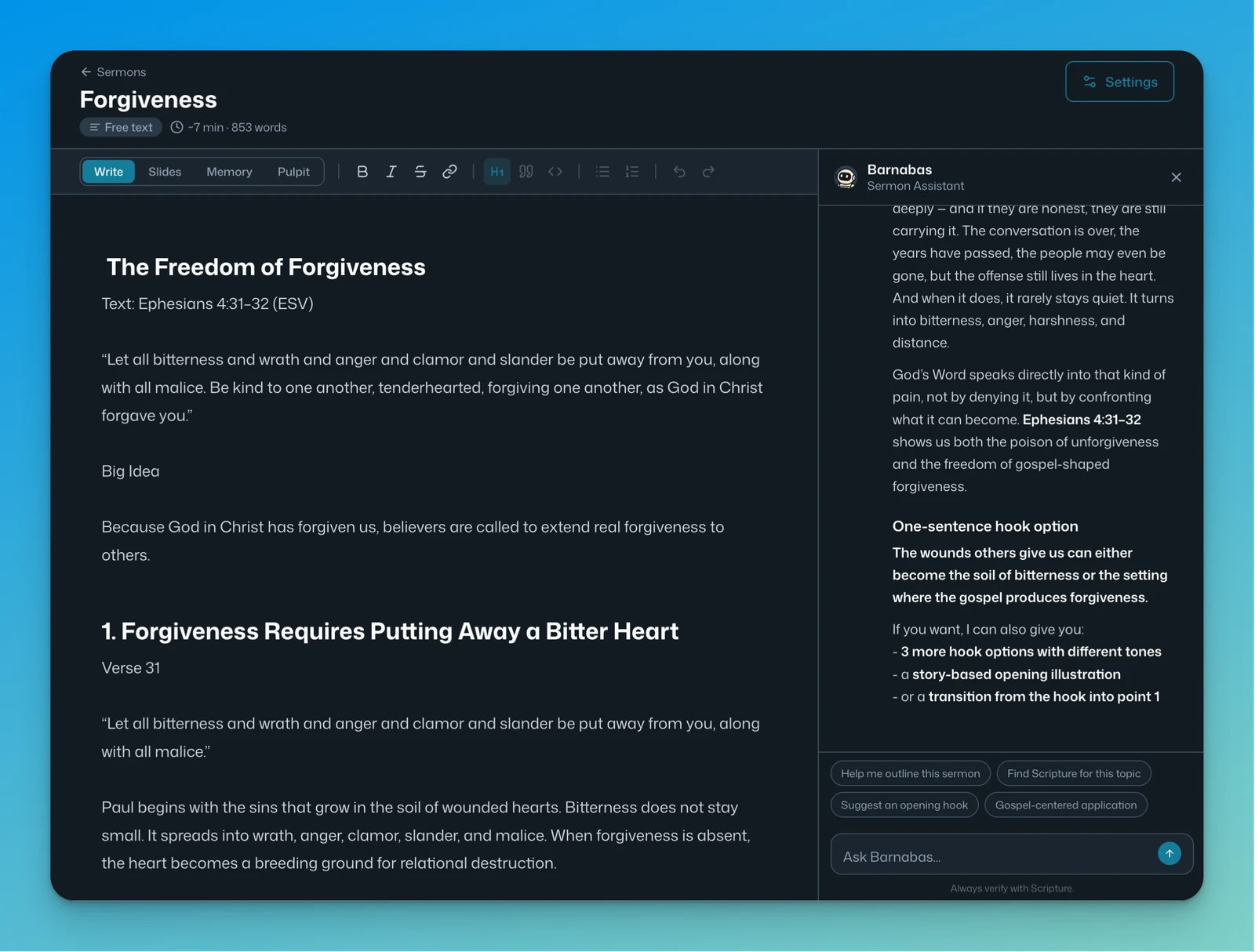
Write the invitation out — every sentence. I draft mine in Sermon Writer inside the Sermons module, where Barnabas writes alongside me in my own voice and memorize mode gets the paragraph into my bones, not just my notes. Make it a call to decision, not reflection: not “think about this,” but “respond to Him, now, here’s how.” Then record yourself delivering it and listen back. Almost every pastor I coach hears the same thing on the recording: he’s rushing. Slow it down. The close is not the off-ramp of the sermon — it’s the destination.
Step 4 — Give people room to respond
The most common way pastors fumble the close isn’t bad theology — it’s bad clocks. We land the gospel, and eight seconds later we’re announcing the men’s breakfast. You just asked people to make the biggest decision of their lives, and you gave them less time than a stoplight.
Build the room in on purpose: a held silence, a verse of the song, a clear next step, heads bowed long enough to actually pray. This Sunday, make sure you’re giving people enough time to respond — and make sure they know exactly what responding looks like in your room. The Spirit doesn’t need your rush.
Step 5 — Shortcut the road-finding, not the conviction
Step 1 — tracing an honest road from the passage to Christ — is the step that takes real study: context, cross-references, how the rest of Scripture picks up this text’s threads. That’s the work the Sermons module in Pastor Center now hands me in minutes: it runs 23 research agents on the passage — historical context, word studies, cross-references, and a synthesis of the commentaries — and returns one cited brief. The cross-reference work alone will show you roads to the cross you’d never have found by Saturday.
Book a 20-minute demo, name the passage you’re preaching next, and the team will send you the full research report — free, yours to keep.
You will preach a lot of sermons your people forget. Don’t let a single one end anywhere but the cross. Find the road, name the lie, write the invitation, and give heaven room to work. That’s the close — every text, every week.
— Elite is a decision. Make it this week.
Elite Preaching
The decisions, craft, and calendar behind elite preaching — the complete system Jon-Michael teaches pastors, in 17 free video lessons.
 ▶
▶+ 13 more lessons — all free
Get the free course
Instant access — every lesson, free forever. No card, no catch.

“If you’re a pastor, you need to know about PastorCenter.”
Josh Howerton · Lead Pastor, Lakepointe Church