Pastor, I stopped preaching my ideas and started preaching the text. Here’s how.

Early in my preaching life I committed the same sin almost every week, and I didn’t even know its name. I’d get an idea on Monday — something I wanted the church to hear — and then I’d go hunting for a passage to hang it on. That’s eisegesis: reading your point into the text instead of pulling meaning out of it. It’s the silent killer of good preaching, because the sermons still sound biblical. They quote Scripture. They just don’t say what Scripture says. A thousand-plus sermons later, here’s the discipline that broke the habit.
Step 1 — Write your idea down, then take it off the table
You can’t pretend you arrive at the text neutral. You don’t. You walk in with a burden, an opinion, a point you’re already half in love with. Fine — but get it out of your system on paper. Before you open the passage, write one sentence: “Here’s what I’m tempted to make this text say.”
That sentence is now a suspect, not a thesis. Your job for the rest of the week is to discover what God said — not to invent what you want Him to say. Naming your bias up front is the only way to keep it from driving.
Step 2 — Interrogate the text before you outline anything
Most eisegesis happens because we outline too early. The outline hardens, and then every observation gets bent to fit it. So delay the outline. Sit in the passage first and ask it questions like a detective, not a defense attorney:
- What did the author actually intend the original hearers to understand?
- What’s in this passage that I would never put in a sermon on this topic?
- What in here makes me uncomfortable — and am I tempted to skip it?
That third question is the tell. The verse you want to skip is usually the verse doing the most work. When the text gets to speak on its own terms, it will surprise you — and a preacher who’s been surprised by the text preaches very differently than one who already knew where he was going.
Step 3 — Check your reading against the historic church
Here’s the orthodoxy test, and it’s saved me from the pulpit equivalent of a car crash more than once: if your interpretation is genuinely novel — if no faithful reader in twenty centuries has seen what you’re seeing — you are almost certainly wrong. You can have incredible delivery, but if the content is off, you’re leading people astray with excellence.
So before the outline, compare your reading against historical church commentary. Not to outsource your conviction — to pressure-test it. Truth is non-negotiable. Every sermon has to stand on theological bedrock, and bedrock, by definition, is the stuff that’s been standing a long time. If the church’s best readers agree with you, build. If they don’t, slow down and find out why. The commentary synthesis in a Deep Sermon Research brief exists for exactly this pressure test — twenty centuries of readers, checked in minutes instead of a shelf-by-shelf Saturday.
Step 4 — Let the passage write the outline
Now — and only now — outline. But here’s the discipline: your points come from the passage’s own structure, not from your Monday idea. If the text moves from problem to promise to command, your sermon moves from problem to promise to command. If your three points can’t each be traced to a verse with your finger, they’re your points, not God’s.
And that Monday sentence from Step 1? Go back and look at it. Some weeks the text confirms it. Most weeks the text corrects it. Either way, the text drove — and your people can feel the difference between a preacher standing under the Word and one standing on it.
Step 5 — Get the exegetical work done in minutes, not days
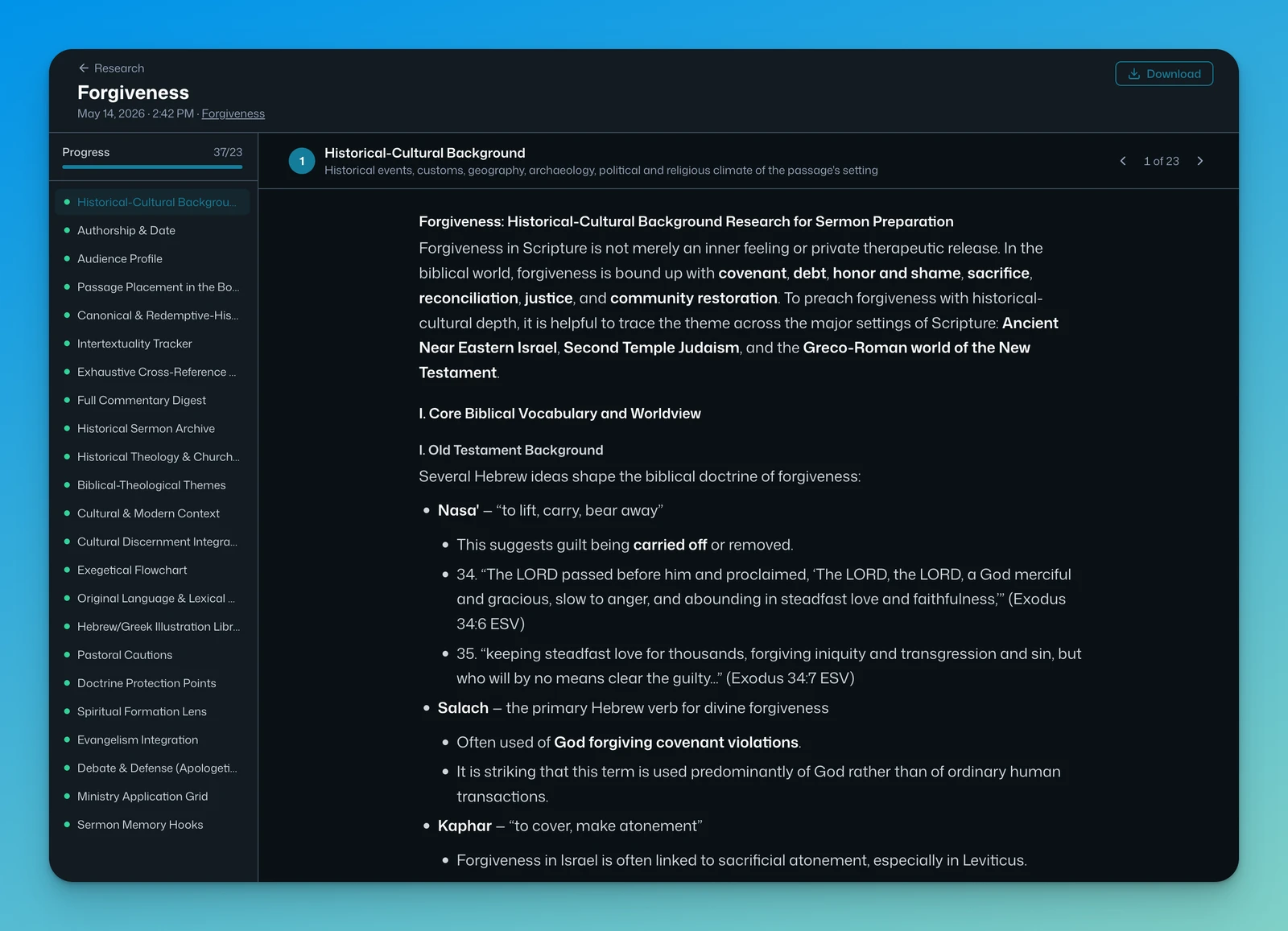
Steps 2 and 3 are where the hours go — context, original languages, and cross-examining the commentaries. It’s also where the Sermons module in Pastor Center changed my week: it runs 23 research agents on your passage at once — historical context, cultural background, original-language word studies, cross-references, and a synthesis of the commentaries — and hands you one cited brief. Every claim is sourced, so the text stays in the driver’s seat and you can check the work.
See what disciplined exegesis looks like on the text you’re actually preaching. Book a 20-minute demo, name the passage you’re preaching next, and the team will send you the full research report — free, yours to keep.
Your congregation doesn’t need your ideas dressed in verses. They need the Word, opened. Run these four steps this week and get out of the way — the text preaches better than you do anyway.
— Elite is a decision. Make it this week.
Elite Preaching
The decisions, craft, and calendar behind elite preaching — the complete system Jon-Michael teaches pastors, in 17 free video lessons.
 ▶
▶+ 13 more lessons — all free
Get the free course
Instant access — every lesson, free forever. No card, no catch.

“If you’re a pastor, you need to know about PastorCenter.”
Josh Howerton · Lead Pastor, Lakepointe Church