How Gregory the Great Preached: A Three-Storey Sermon With the Roof Built Longest
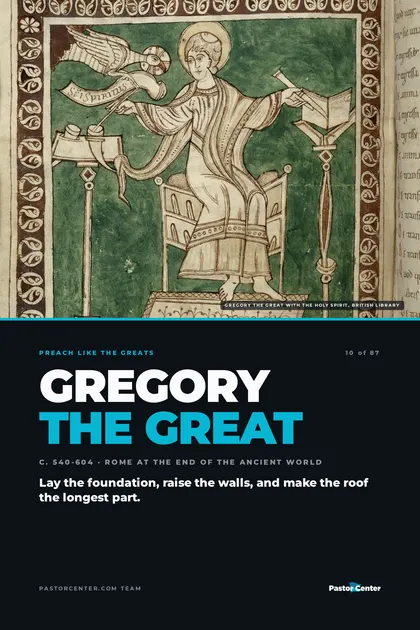
Gregory the Great was a monk who became pope in 590 and preached to crowds in Rome’s basilicas at the end of the ancient world. We studied nine of his homilies, most of them from the Gospel homilies of 590 to 593, plus excerpts from his homilies on Ezekiel. The shape is a building: lay the literal foundation, raise the spiritual walls, and make the moral roof the longest part. Then tell a true, local story and close with a plea and praise.
Who Gregory the Great was
Gregory preached 40 Gospel homilies in Rome’s basilicas between 590 and 593, and 22 homilies on Ezekiel during the Lombard siege of the city. His sermons drew large crowds, and his habit of closing with a true story set the pattern for medieval preaching.
His Pastoral Rule served as the church’s handbook for pastors for a thousand years and “remained for centuries the textbook of the Catholic episcopate.” King Alfred translated it into Old English around 890 and sent a copy to every bishop in his kingdom. Gregory also sent the mission that brought the gospel to the English.
The shape of a Gregory sermon
He opens on the Gospel that has just been read, often by naming a puzzle in it. “Why John…?” is the kind of question that gets him started.
Next comes the literal sense, what the text says on the ground. Then a separate allegorical section raises the spiritual meaning. In the laborers in the vineyard, the householder is God and the hours become the ages of the world, then the stages of your own life.
Somewhere around a third of the way in, he turns plainly to “you,” and the moral application usually becomes the longest block of the sermon. He shaped it for different kinds of hearers: “out of one doctrine, but not with one and the same exhortation.”
In the back third he often tells a true story from outside Scripture, recent and local: last week’s storm that razed churches, his own aunts, a monk freed by the brothers’ prayer. Then comes a “dearest brethren” exhortation and a close in worship.
What made his preaching different
A three-storey reading
He reads each text on three levels: a literal foundation, spiritual walls and a moral roof. The roof, where the text meets the hearer’s life, gets the most room.
A true, local story
Near the end he tells a recent story from Rome that his hearers could check for themselves. It makes the truth feel close and real.
Plea, then praise
He closes with judgment and hope pressed on the hearers, then turns to worship. The last note is praise, not pressure.
What others said
“Whatsoever he taught in word, that he fulfilled in deed.”
— Gregory’s epitaph, quoted by Bede
“We may rightly, nay, we must, call him our apostle.”
— Bede
What to take into your own pulpit
Build the roof biggest
Explanation is the foundation, not the house. Give the most time to what the text asks of the people in the room.
Use stories your hearers can check
A true, recent, local story lands harder than a borrowed one. Gregory reached for events his listeners knew.
Shape one truth for different people
The same doctrine can carry different exhortations. Think about who is listening and press the point where each one needs it.
Those are the ideas. The guide turns them into ten steps you can follow this week, plus the sermons we studied and a fill-in outline in his shape.
Free PDF · Preach Like the Greats
Learn to preach like Gregory the Great.
This post is the overview. The guide has the research and the method.
- The 9 sermons we studied, start to finish
- Ten steps to preach the way he did
- His sermon outline, movement by movement
- A fill-in template for your own text, 10 pages
Common questions
What was Gregory the Great’s preaching style?
Pastoral and layered. He read the Gospel of the day on three levels, literal, spiritual and moral, gave the most time to moral application, told a true local story near the end, and closed with a plea and praise.
How did Gregory the Great structure a sermon?
He opened on the Gospel just read, often with a puzzle, explained the literal sense, raised an allegorical reading, turned to “you” for a long moral section, told a true story, and ended with a “dearest brethren” exhortation and doxology.
What is Gregory the Great’s Pastoral Rule?
It is his handbook for pastors, which served the church for a thousand years. King Alfred translated it into Old English around 890 and sent a copy to every bishop in his kingdom.