How Augustine of Hippo Preached: Talking With the Crowd, Not At Them
Augustine of Hippo preached an estimated 8,000 sermons to a congregation that stood, and stenographers took many of them down as he spoke. We studied ten of them, on the Gospels, the Psalms and 1 John. Under every one sits the same shape: the reading, the hardest puzzle in it, a conversation with the crowd, a homely image, and a road to the whole Christ and to love.
Who Augustine of Hippo was
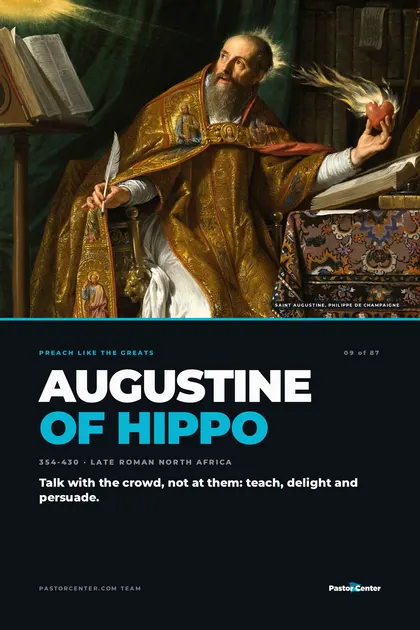
Augustine preached for about 40 years as a priest and then bishop of Hippo in North Africa. Roughly 500 to 550 of his sermons survive, and new ones are still being found: 26 in Mainz in 1990 and 6 in Erfurt in 2008.
As a priest he was allowed to preach in his bishop’s presence, against the custom of the African churches, and other bishops followed the example. Book IV of his On Christian Teaching was the first Christian handbook on preaching, and his rule for the preacher came from Cicero: “to teach, to delight, and to persuade.”
The shape of a Augustine sermon
He started with the reading and went straight to its hardest question. In Sermon 51 the puzzle is the “contradictions” between the genealogies, and he answers the objections one by one until Joseph stands as a true father by love.
Then he talked with the crowd. He read their faces out loud, voiced their questions and answered them as if they had raised a hand. The sermon feels less like a lecture and more like a conversation he is leading.
Every abstract idea got a picture people could see. The eternal Word is like the word in your heart before you speak, and a carpenter has the box “in design” before he builds it. Wordplay did the same work, giving people a phrase to carry home.
And the sermon always went somewhere bigger than the verse. Every text led to the whole Christ, head and body, and then to love, before turning the hearers toward God.
What made his preaching different
He talked with the crowd
He read their faces out loud and voiced their questions. The crowd heard their own objections answered before they could leave with them.
A homely picture
Every abstract idea got an image people could see, from the carpenter’s design to the many grains made into one bread.
Christ and love
Every text led to the whole Christ and to love. “Love, and do what you will” comes out of a sermon on 1 John that weighs the love behind an act.
What others said
“It was not… when I heard their applause, but when I saw their tears, that I thought I had produced an effect.”
— Augustine, On Christian Teaching 4.24.53
“much more earnestly and fervently and with greater authority.”
— Possidius, his friend and biographer, c. 432 (Life of Augustine 9)
What to take into your own pulpit
Name the hard question first
Augustine went looking for the puzzle in the text. People listen harder when the sermon is solving something they noticed too.
Talk with the room
Say their questions out loud and answer them. A sermon can be a conversation even when only one person is speaking.
Give every idea a picture
If an idea can’t be seen, it won’t be remembered. Reach for the everyday image that makes it plain.
Those are the ideas. The guide turns them into ten steps you can follow this week, plus the sermons we studied and a fill-in outline in his shape.
Free PDF · Preach Like the Greats
Learn to preach like Augustine of Hippo.
This post is the overview. The guide has the research and the method.
- The 10 sermons we studied, start to finish
- Ten steps to preach the way he did
- His sermon outline, movement by movement
- A fill-in template for your own text, 8 pages
Common questions
What was Augustine of Hippo’s preaching style?
Conversational, vivid and aimed at the heart. He talked with the crowd, voiced their questions, gave every abstract idea a homely image and led every text to the whole Christ and to love.
How did Augustine structure a sermon?
The reading, the puzzle in it, a dialogue with the hearers, an image or bit of wordplay, the whole Christ, love, and a turn to God.
How many sermons did Augustine preach?
An estimated 8,000 over about 40 years. Roughly 500 to 550 survive, and new ones are still being found.