How Mike Schmitz Preaches: Name the Blind Spot, Define It, Give a Practice
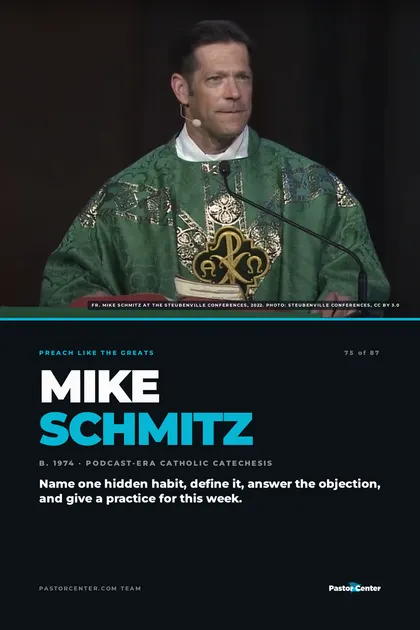
Fr. Mike Schmitz preaches like a man talking with one student across a table. We studied six of his homilies and talks from 2025 and 2026. Each one follows the same path: name one hidden habit of the heart, define it, answer the objection the listener is already forming, and give a practice for this week.
Who Mike Schmitz is
Schmitz was ordained a priest for the Diocese of Duluth in 2003 and serves as chaplain of the Newman Catholic Campus Ministry at the University of Minnesota Duluth, where his Sunday homilies are filmed and posted every week. He says nearly every homily he posts “comes from a conversation I’ve had with students.” Since 2015 he has hosted Ascension Presents on YouTube.
The Bible in a Year podcast debuted in 2021 at No. 1 among all U.S. podcasts on Apple, held the top spot from January 2 to 18, and returned to No. 1 in January 2022. Ascension reports more than one billion all-time downloads. The Catechism in a Year followed on January 1, 2023, and Our Sunday Visitor named him and Jeff Cavins among its 2021 Catholics of the Year. He has also published How to Make Great Decisions (2019) and Unshakeable (2025).
The shape of a Schmitz sermon
He usually opens with a personal or pop-culture story before any text: a camp breakfast, hearing his own recorded voice, The Lion King told straight and then revealed. Many homilies belong to a named series, like “Blind Spots.”
Early on he names the one theme with a short label, and he tends to build on one reading rather than all three. Then he defines it. A word study or borrowed definition does the work: sin as “sundered,” “perspective” as “see through.”
The turn is usually a contrast pair, like concern vs. worry or lament vs. complaint. He voices the objection the listener is forming (“Are you supposed to say nothing?”) and answers it. He stacks voices freely along the way: a saint, a C.S. Lewis line, a study, a story from his own campus.
In the last part of the homily he names a remedy or practice, such as three phrases to shut gossip down. Then he signposts the close with “this is the last thing” and ends on a final story or recap.
What made his preaching different
Label the blind spot
He gives each homily’s theme a short, sticky name, like “blind spots” or “eternal perspective.” The label lets people catch the habit in themselves later.
Define, then distinguish
Word studies and clean lines like concern vs. worry separate the healthy thing from the unhealthy one. The distinction is where the homily turns.
The last thing
He tells the room he is closing with “this is the last thing,” then ends on one story. Everyone knows where they are.
What others said
“Each homily ran for somewhere between 20 and 30 minutes, but the priest managed to hold my attention the entire time.”
— Monica Doumit, The Catholic Weekly, 2025
“Fr. Schmitz brings the Word to life. He is easy to listen to.”
— Sandee Kremers, pastoral associate, St. Francis Xavier, Sartell, Minn., 2022
What to take into your own pulpit
Name the thing they can’t see
A short label for a hidden habit helps people spot it in themselves. Give the blind spot a name.
Draw the line that clarifies
Concern isn’t worry. Lament isn’t complaint. A clean distinction often teaches more than a long explanation.
Answer the objection out loud
Someone is already arguing with you in their head. Say their question before they finish thinking it.
Those are the ideas. The guide turns them into ten steps you can follow this week, plus the sermons we studied and a fill-in outline in his shape.
Free PDF · Preach Like the Greats
Learn to preach like Mike Schmitz.
This post is the overview. The guide has the research and the method.
- The 6 sermons we studied, start to finish
- Ten steps to preach the way he does
- His sermon outline, movement by movement
- A fill-in template for your own text, 9 pages
Common questions
What is Mike Schmitz’s preaching style?
Conversational, plain and self-mocking. He names one hidden habit with a sticky label, defines it with a word study, draws a clean contrast, answers the listener’s objection, and gives a practice for the week.
How does Mike Schmitz structure a homily?
He opens with a personal or pop-culture story, names the theme with a short label, builds on one reading, defines and distinguishes, answers an objection, names a remedy or practice, and signposts the close with “this is the last thing.”
Where do Fr. Mike’s homilies come from?
He says nearly every homily he posts “comes from a conversation I’ve had with students.” They are filmed at the Newman Catholic Campus Ministry at the University of Minnesota Duluth and posted every week.