Pastor, I get seminary-depth research on any passage in 10 minutes. Here’s how.

I used to believe deep research required deep hours — that ten hours in the books was the price of a faithful sermon. Then I realized the hours weren’t the depth. The layers were. Get the right four layers on any passage and you have seminary-depth research, whether it took ten hours or ten minutes. Here’s the stack I run every single week.
Step 1 — Read the text before you touch a tool
This one is non-negotiable, and it costs you nothing. Before any commentary, any software, any AI — read the passage slowly, out loud, twice. Write down what it actually says, what surprises you, and what you don’t understand yet.
Why first? Because research answers questions, and you can’t ask good questions about a text you haven’t sat with. The pastors who skip this step don’t save time — they lose it, wandering through commentaries hoping something preaches.
Step 2 — Nail the context
Meaning lives in context. Three kinds, every time:
- Historical — who wrote it, to whom, and what was happening to them?
- Cultural — what would the original hearers have assumed that we don’t?
- Literary — what comes right before and after, and what genre am I in?
Most preaching errors I’ve heard — including my own early ones — weren’t theology errors. They were context errors: a promise to exiled Israel preached as a promise to a suburban job search. Context is where faithfulness is won or lost.
Step 3 — Chase the load-bearing words
You don’t need to parse every word in Greek or Hebrew. You need the hinge words — the two or three terms the passage’s meaning actually turns on. Find them, run the word study, and check how the same author uses that word elsewhere.
When I preach Philippians 2, everything hangs on what “emptied himself” means. Get that word right and the sermon stands. Skim it and you’re guessing in public.
Step 4 — Synthesize the commentaries, don’t collect them
Here’s where the ten hours used to go: reading six commentaries cover to cover and copying quotes. Wrong job. The commentaries aren’t there to be read — they’re there to be cross-examined. Where do they agree? That’s bedrock; build on it. Where do they disagree? That’s your signal to slow down and study harder — and to be honest about the debate from the pulpit.
Consensus and disagreement. That’s the whole synthesis. Everything else is note-taking theater.
Step 5 — Run all four layers at once
For most of my ministry, that stack took the better part of two days. Now it takes minutes: the Sermons module in Pastor Center runs 23 research agents on your passage at once — historical context, cultural background, original-language word studies, cross-references, and a synthesis of the commentaries — and hands you one cited brief. Every claim sourced, so you can check the work.
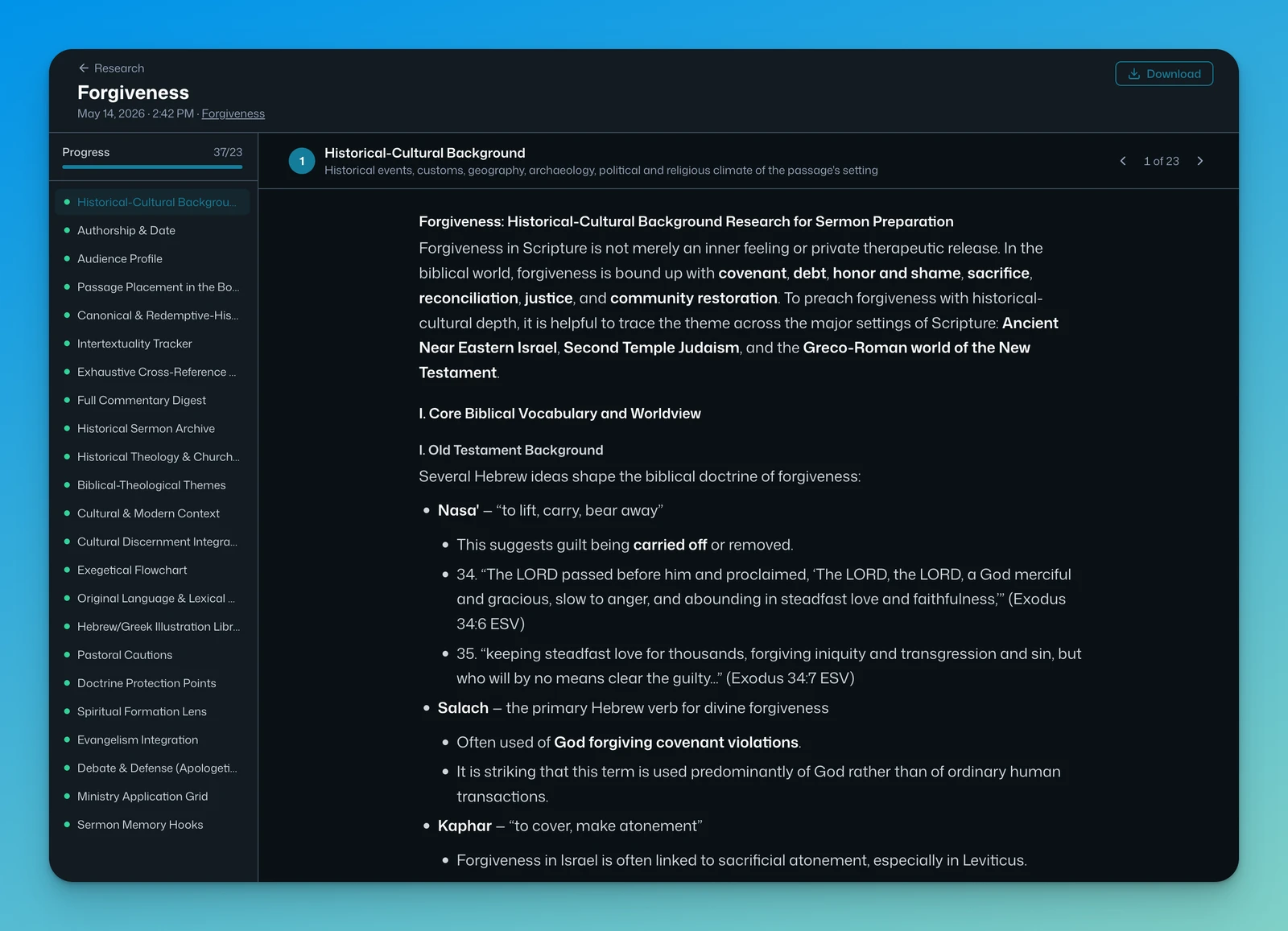
Don’t take my word for it. Book a 20-minute demo, name the passage you’re preaching next, and the team will send you the full research report — free, yours to keep, whether or not you ever subscribe.
The depth was never in the hours. It’s in the layers. Run all four this week — however long it takes you — and your congregation will hear the difference on Sunday.
— Your next sermon’s research is already done.
Preaching Masterclass
Eric’s complete preaching framework — faithful exegesis, structure that achieves the goal, stories that stick, and endings that land on the gospel.
 ▶
▶+ 9 more sessions — all free
Get the free course
Instant access — every lesson, free forever. No card, no catch.

“If you’re a pastor, you need to know about PastorCenter.”
Josh Howerton · Lead Pastor, Lakepointe Church