How Mark Driscoll Preaches: The Spoiler Up Front, Then Verse by Verse
Mark Driscoll teaches whole books of the Bible verse by verse, but he preaches them like a stand-up set with a lesson plan. We studied six of his sermons, from around 2021 to 2026. The shape holds steady: the big idea given away in the first minute, a few verses read at a time, numbered lists, and one question asked of the text: how does this point to Jesus?
Who Mark Driscoll is
Driscoll was born October 11, 1970, in Grand Forks, North Dakota. He studied communication at Washington State University and earned a master’s degree in exegetical theology from Western Seminary. He co-founded Mars Hill Church in Seattle, which held its first official service in October 1996 with 160 people. By 2013 it averaged more than 12,000 in weekly attendance across campuses in several states.
Mars Hill was an early adopter of putting full sermons online and delivering them by video to other campuses, with more than 260,000 online sermon views a week by about 2008. In 2011 Preaching magazine named him one of the 25 most influential pastors of the past 25 years. Since 2016 he has preached at The Trinity Church in Scottsdale, Arizona, and through his Real Faith ministry.
The shape of a Driscoll sermon
Every sermon we studied opens with a welcome and a note on where the book or series stands. Then he gives away the big idea or a numbered roadmap almost immediately: “here’s the spoiler alert.”
He reads a few verses, comments, then reads on. The body is built on numbered lists (big ideas, questions, objections, ways), with background “nerd facts” like word studies, ancient historians, costs and counts. A joke or self-deprecating aside comes every few minutes.
He keeps turning to the room with “How many of you…” and naming their exact situations. He often says he is departing from his notes: “I just feel I’m supposed to say this.”
In Old Testament texts he asks one question over and over: how does this point to Jesus? Most sermons draw Christ or the cross out of the text, and they close with a numbered application list, a prayer or an invitation.
What made his preaching different
Spoiler up front
He states the big idea or a numbered roadmap in minute one, so the room knows where the sermon lands before it starts.
Read, then talk
He reads a few verses, then comments, jokes and applies, and then reads on.
Find Jesus there
He asks of every text how it connects to Jesus, especially in the Old Testament.
What others said
“Dynamic and funny, with a potent mix of reverence for Jesus and irreverence for everything else.”
— The Seattle Times
“This untucked, down-to-earth demeanor was the opposite of a huckster televangelist, but polished in its own way.”
— Crosscut, 2014
What to take into your own pulpit
Give away the ending
Stating the big idea up front lets people follow the argument instead of guessing where it’s going.
Read in small bites
Reading a few verses and then explaining them keeps the text in front of the room the whole time.
Ask where Jesus is
Before you apply an Old Testament passage, ask how it points to Christ.
Those are the ideas. The guide turns them into ten steps you can follow this week, plus the sermons we studied and a fill-in outline in his shape.
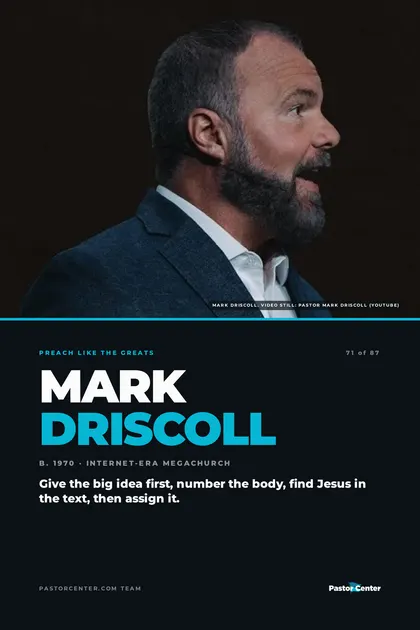
Free PDF · Preach Like the Greats
Learn to preach like Mark Driscoll.
This post is the overview. The guide has the research and the method.
- The 6 sermons we studied, start to finish
- Ten steps to preach the way he does
- His sermon outline, movement by movement
- A fill-in template for your own text, 9 pages
Common questions
What is Mark Driscoll’s preaching style?
Verse-by-verse teaching delivered with humor and direct address. He gives the big idea first, reads a few verses at a time, builds on numbered lists and background facts, and asks how each text points to Jesus.
How does Mark Driscoll structure a sermon?
A welcome and series recap, a big idea or numbered roadmap in the first minutes, a body of short readings with comment and numbered lists, Christ drawn out of the text, and a close with an application list, prayer or invitation.
Who influenced Mark Driscoll’s speaking style?
He wrote in 2006 that his public speaking style is influenced by stand-up comedians like Chris Rock.