Pastor, I stopped begging for volunteers from the stage. Here’s what actually works.

“We really need help in kids ministry — please see me after service.” I said some version of that from the stage for years. It never worked, and it took me too long to understand why: the general ask recruits guilt. And guilt shows up late, serves reluctantly, and quits by Christmas. Here’s the system that replaced it — and actually filled the teams.
Step 1 — Retire the general announcement
The stage ask fails for a structural reason, not a delivery reason: it broadcasts a vague need to everyone, so the people who respond are the ones most susceptible to obligation — not the ones gifted for the role. You get the wrong people in the wrong seats, feeling conscripted. Then they burn out, and now recruiting is harder and you’ve wounded a good sheep.
Announcements can celebrate serving. They cannot recruit for it. Retire the ask.
Step 2 — Name every open seat
You can’t recruit to a fog. “We need help” is a fog. “We need two check-in hosts for the 9 a.m., one 4th-grade table leader, and a sound tech in training” is a recruiting list.
Sit down and write every serving role your Sunday actually requires — filled and open, by service time. Most pastors have never done this once, and it shows: you’ve been asking a congregation to volunteer for positions you haven’t defined. The list will sting. It’s also the first honest picture of the need you’ve ever had.
Step 3 — Discover gifts before you ask
Here’s the flip that changes everything: stop asking “who will fill this seat?” and start asking “who is built for this seat?” People quit roles they were guilted into and stay for years in roles that fit their gifting — because serving in your gifting doesn’t drain, it produces joy. That’s not a program; that’s Romans 12 and 1 Corinthians 12 doing what they were written to do.
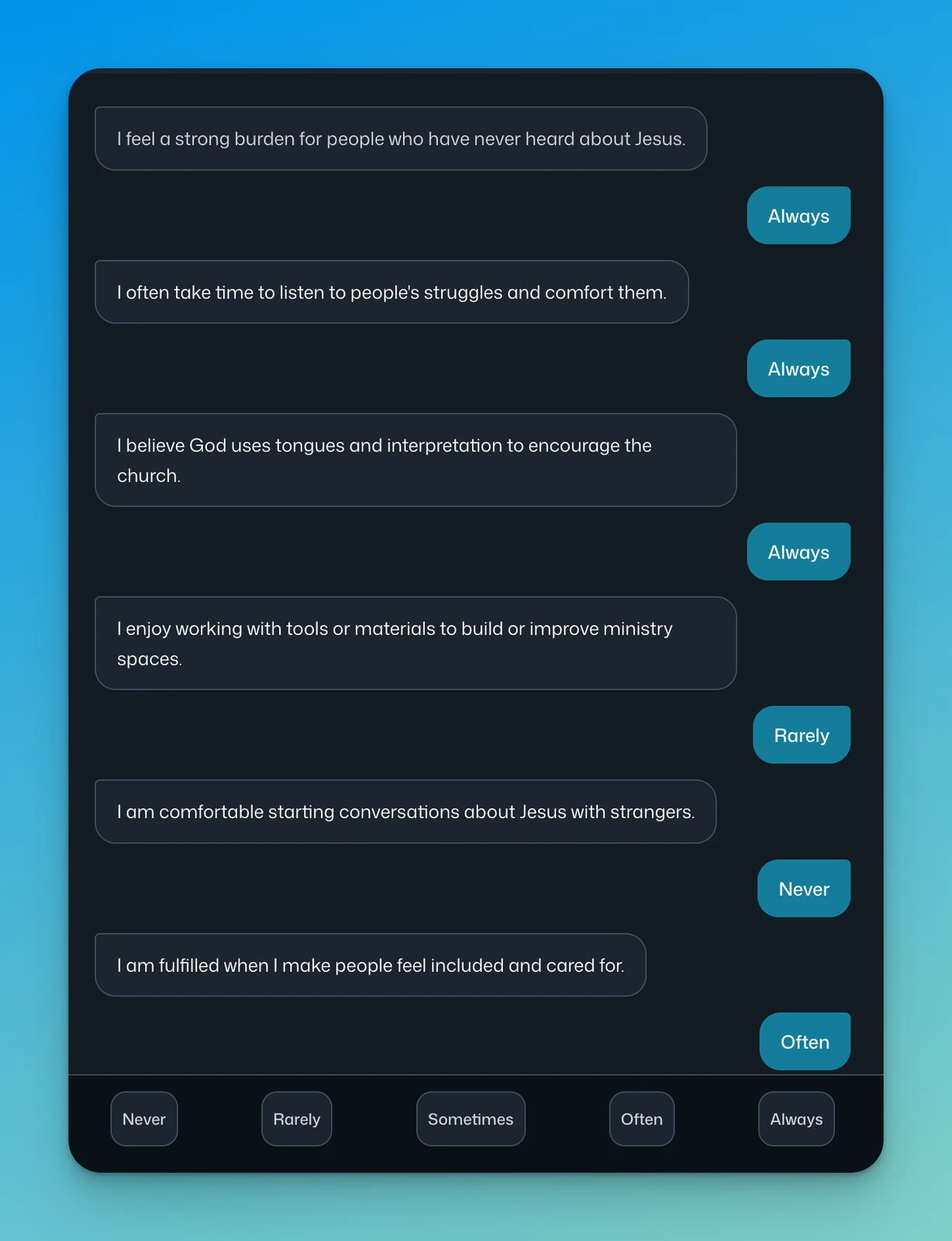
Practically: run a spiritual gifts assessment across your congregation — not a card-table sign-up sheet, an actual assessment of gifting and wiring. The one we built asks 112 questions across 24 gifts and four DISC dimensions, takes about 20 minutes on a phone, and reads like plain English, not seminary. Now your recruiting list from step 2 has a matching talent list.
Step 4 — Ask personally, specifically, with an off-ramp
The ask itself, done right, is nearly irresistible because it’s an honor instead of a plea: “Sarah, your assessment says teaching and shepherding — that’s exactly what our 4th-grade room needs. Would you try it for 90 days? If it doesn’t fit, you hand it back, no hard feelings.”
Personal, because you sought them. Specific, because the seat is defined. Time-boxed, because the 90-day off-ramp removes the fear of a life sentence — and almost nobody who fits their seat takes the off-ramp.
Step 5 — Run the discovery at scale
Step 3 is the bottleneck when you’re doing it with paper forms and a spreadsheet. The Spiritual Gifts module sends a full gifts + DISC assessment to your whole congregation and turns the results into a searchable dashboard — filter by gift, see who’s wired for kids or hospitality or prayer, and match people to your open-seat list from step 2. The begging ends because the guessing ends.
Book a 20-minute demo and the team will run the full assessment on your staff at no cost — see the results on people you already know before you send it to the whole church.
Retire the announcement. Name the seats. Discover the gifts. Make the honor-ask. You’ll never beg from the stage again — and your teams will finally stop leaking.
— Your best volunteers are already sitting in your pews.
Elite Serving Teams
Your growth ceiling is a team problem, not a preaching problem. The eight key teams and the leadership tree that break it.
 ▶
▶+ 12 more lessons — all free

Get the free course
Instant access — every lesson, free forever. No card, no catch.

“If you’re a pastor, you need to know about PastorCenter.”
Josh Howerton · Lead Pastor, Lakepointe Church