Pastor, here’s how I filled every serving seat — without burning out my faithful few.

Every church has them: the faithful few who do everything. Sound board, then a kids room, then locking up — every Sunday, every seat. We call them pillars and thank God for them, but let’s be honest about what’s happening: the church is being carried instead of staffed, and the people carrying it are quietly wearing out. Here’s how to fill every seat while giving your best people their Sundays back.
Step 1 — Audit the load
Write down every serving role a Sunday requires, then put a name beside each one. Now count how many times each name appears. In most churches the math is brutal: ten or fifteen names covering the large majority of the roles, many of them serving two and three slots per service.
This audit tells you two things. The real number of seats you’re running (bigger than you thought), and your true exposure: when one of those over-loaded saints moves away or finally breaks, you don’t lose a volunteer — you lose a department. Growth stalls here too, quietly: a serving structure at capacity caps the church at its current size no matter how good the preaching gets.
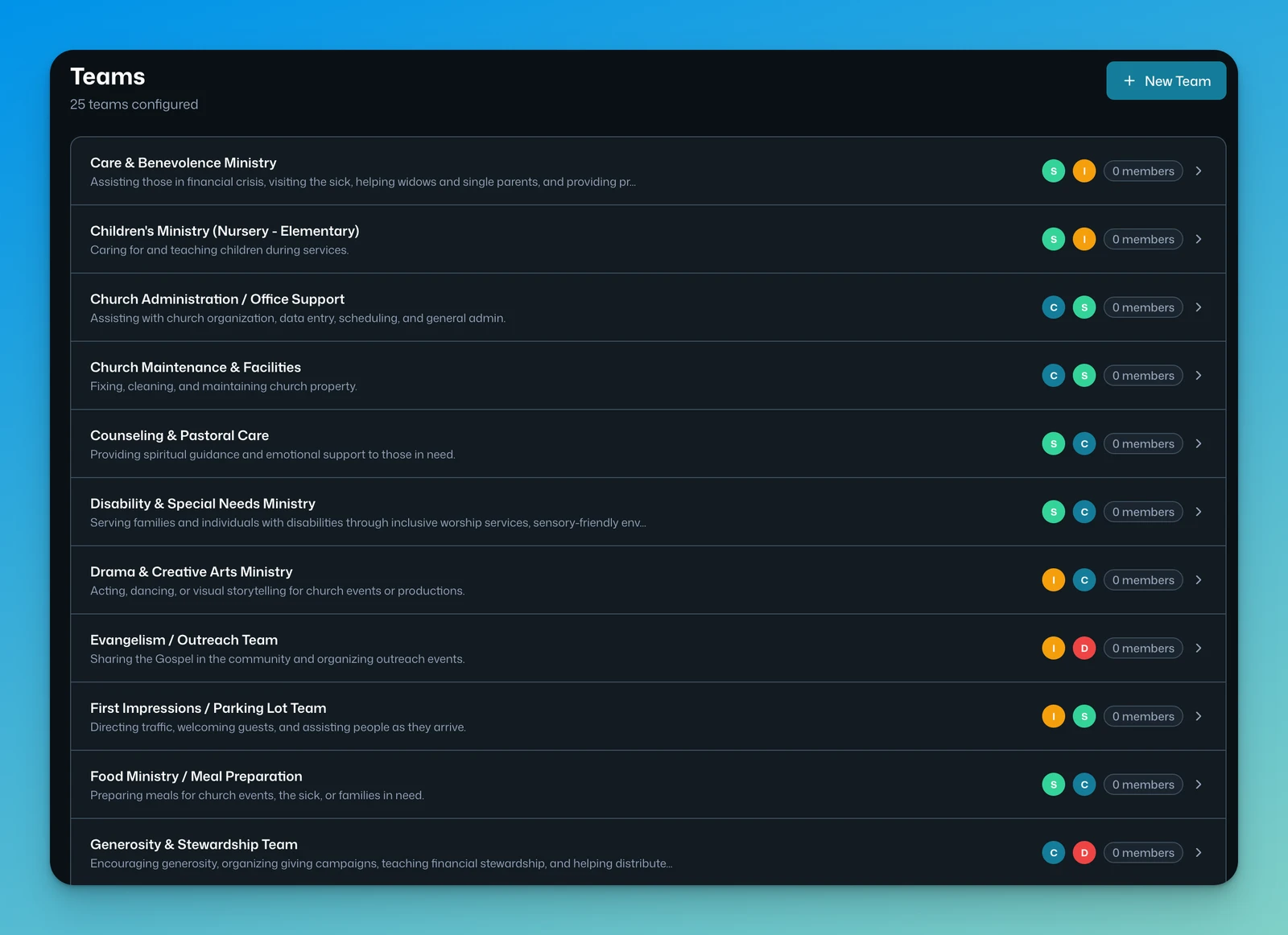
This audit is brutal on a spreadsheet and quick with the roster tools in Spiritual Gifts — every team configured by name, synced with Planning Center, one place to see who’s serving where. The repeat names jump off the screen.
Step 2 — Build A and B teams
The goal isn’t one person per seat. It’s two rotating teams per department — A team serves this week, B team next. Serving every other week is a pace people can hold for a decade; serving every week is a pace that ends in a resignation text. Rotation is retention.
Yes, this doubles the number of people you need, and that feels impossible from inside the shortage. But hear the counterintuitive part: the every-other-week ask is dramatically easier to say yes to. Half your recruiting problem is that the only ask you’ve been making — every week, indefinitely — is an ask only the heroic accept. Shrink the ask and the pool grows.
Step 3 — Widen the pool with gifting
Where do the new names come from? Not from re-asking the exhausted. From the eighty-plus percent of your congregation that has never served — most of whom aren’t unwilling. They’ve just never been asked in a way that had anything to do with them.
Run a spiritual gifts assessment across the whole church, then recruit from the results: the teaching-and-mercy-gifted for kids, the natural warmth for first impressions, the quiet intercessors for prayer. A personal, gift-matched, every-other-week invitation converts at a rate the stage announcement never touched — because it’s an honor, not a plea for relief.
Step 4 — Put a leader over every team
Now protect what you built. Unled teams leak: people don’t quit serving, they quit chaos — nobody scheduled them, nobody trained them, nobody noticed they came. Every team gets a named leader whose job is not to do the work but to own the roster: schedule, train, check in, celebrate. Your fastest-growing leadership pipeline is hiding here too — the dependable B-team member who’s ready to own a roster is tomorrow’s department head.
Step 5 — Run the whole engine in one place
Steps 1 through 4 need a congregation-wide picture of gifting and a way to match people to seats. That’s the Spiritual Gifts module: the assessment goes to everyone, results land in one dashboard, and each person gets matched to the teams their gifts fit — so your A/B rosters fill from data instead of desperation.
Book a 20-minute demo and the team runs the full gifts + DISC assessment on your staff at no cost — a live preview of what it looks like across the whole church.
Audit the load. Build the rotation. Recruit by wiring. Lead every team. Your faithful few didn’t sign up to carry the church alone — build the benches that let them love serving again.
— Your best volunteers are already sitting in your pews.
Elite Serving Teams
Your growth ceiling is a team problem, not a preaching problem. The eight key teams and the leadership tree that break it.
 ▶
▶+ 12 more lessons — all free

Get the free course
Instant access — every lesson, free forever. No card, no catch.

“If you’re a pastor, you need to know about PastorCenter.”
Josh Howerton · Lead Pastor, Lakepointe Church