Pastor, more effort won’t get your church unstuck. Here’s how I restart momentum in 4 steps.

I’ve sat with a lot of pastors of stuck churches, and almost every one of them has tried the same fix: more. More meetings, more pressure, more communication, more activity. It produces a lift for a few weeks — and then the church settles right back into stuck, except now everybody’s more tired. Here’s the diagnosis I wish someone had given me earlier, and the four steps I use to restart momentum.
Step 1 — Stop misdiagnosing the problem
When momentum fades, the issue is almost never effort. In most stuck churches the leaders are deeply committed and the teams are giving everything they have. The real problem: the way the church functions can no longer support what it’s trying to carry. Effort can compensate for that for a season — it cannot sustain health over time.
Here’s the conviction underneath everything I teach: God sends momentum. The Holy Spirit builds the church. But leaders are responsible for stewarding what He builds — and stewardship means structure. If your church experienced real momentum and lost it, the momentum didn’t fail. The structure holding it did.
Step 2 — Get strategic clarity before you change anything
Don’t start with new programs. Start with a small room — you and your most trusted leaders, eight people or fewer — and work through the questions that actually define a church: Why do we exist? What are we uniquely called to do? Where is God leading us? Who are we specifically trying to reach? What’s holding us back? What are we not seeing?
Stuck churches are almost always unclear churches. Everyone’s working; nobody’s working on the same thing. Clarity is never accidental — it has to be built, revisited, and reinforced. This meeting is where the rebuild starts.
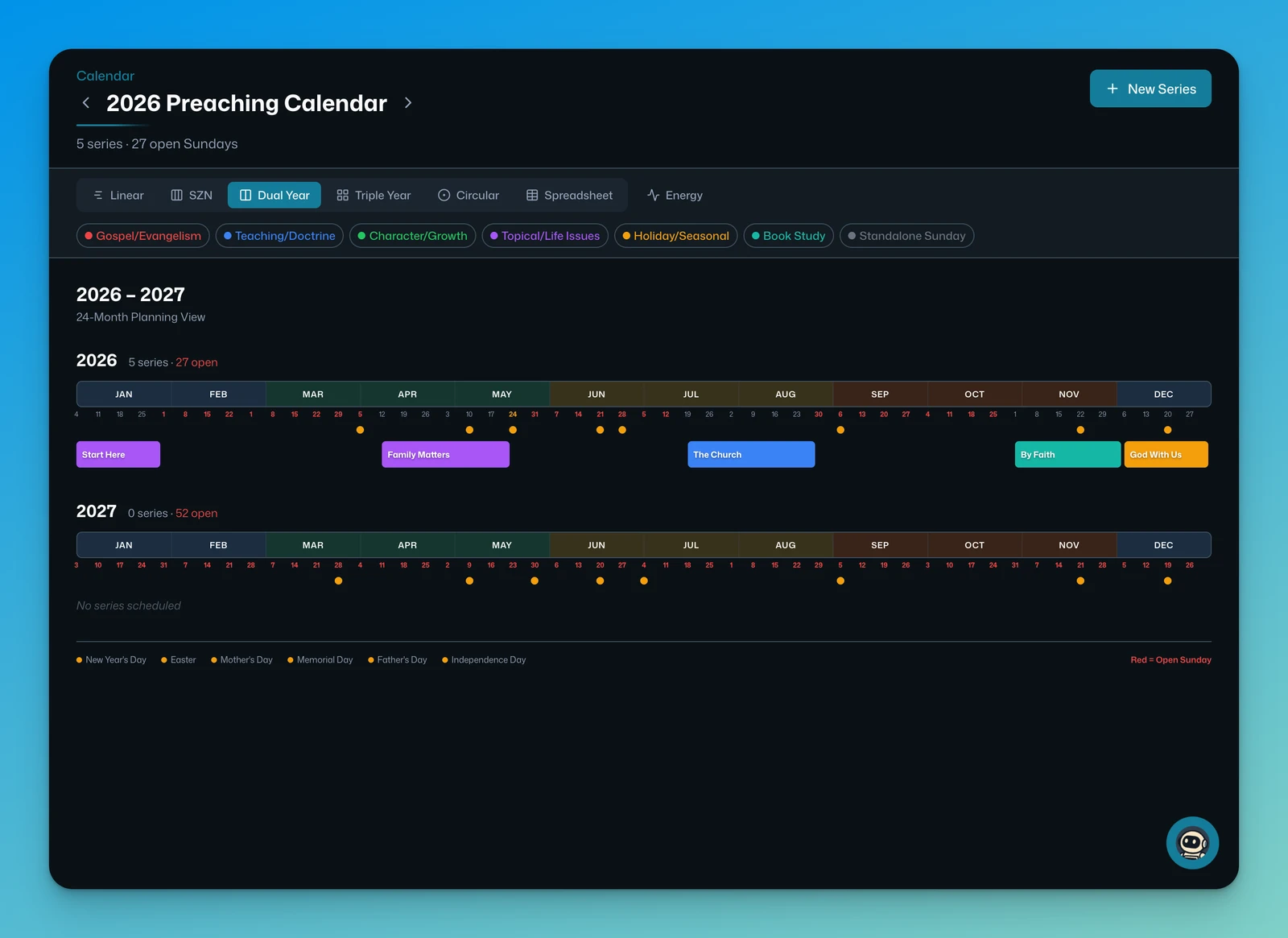
One practical output of that room: your preaching. Once we’ve answered where God is leading us, I map the year’s series in the Sermon Calendar — I talk to Barnabas about the vision that came out of that meeting and it plans the rest — so the pulpit spends twelve months reinforcing the plan instead of wandering away from it.
Step 3 — Pick five priorities and put a name on each
Out of that clarity, name the five things this year that would actually move the needle — not twenty, five. Then turn each one into a 90-day objective with three things attached: exactly what will be accomplished, one person who owns it, and a date it’s done by.
“Improve our follow-up” is a wish. “Launch a follow-up process that contacts every first-time guest within 48 hours — owned by Sarah, done by September 30” is a plan. Stuck churches have wishes. Moving churches have owners and deadlines.
Step 4 — Build the weekly rhythm that keeps it alive
This is the step everyone skips, and it’s why January plans are dead by March. Every week, fifteen minutes, same questions for every objective: What’s complete? What’s in progress? Where are you stuck? What needs attention this week?
Progress becomes visible. Drift becomes obvious. Focus stays clear. Momentum isn’t restarted by a great off-site — it’s restarted by a boring, faithful weekly rhythm that refuses to let the plan die.
Step 5 — Take the full system, free
Those four steps are the skeleton of a system I’ve been building since 2018 and have now run in my own church and every church I consult — every one of them has grown. I taught the whole thing, free, in eight short sessions: the Momentum course — strategic clarity, annual priorities, 90-day ITAs, lead measures, and the weekly execution meeting, about 75 minutes end to end.
Restarting momentum eventually means putting the right people on the right problems. Book a 20-minute demo and we’ll run the full spiritual gifts + DISC assessment on your staff free — so when you assign those five priorities, they land on people built to carry them.
Your church isn’t stuck because you stopped working hard. It’s stuck because effort is being asked to do a job that belongs to structure. Build the structure — and watch what God sends next actually stick.
— Your church doesn’t need more. It needs momentum.
Momentum
The operating system behind Hope City — strategic clarity, annual priorities, 90-day ITAs, lead measures, and the weekly execution rhythm that turns vision into what actually happens.
 ▶
▶+ 4 more sessions — all free
Get the free course
Instant access — every lesson, free forever. No card, no catch.

“If you’re a pastor, you need to know about PastorCenter.”
Josh Howerton · Lead Pastor, Lakepointe Church