Pastor, here’s how I break growth barriers — and it’s not what you think.

I planted a church that grew from a launch team to 4,000 in four years, and here’s what surprised me about every ceiling we hit: the breakthrough was never where I was looking for it. What worked at 100 doesn’t work at 300, and what worked at 300 doesn’t work at 1,000. Growth barriers usually aren’t passion problems, vision problems, or even preaching problems — they’re structure problems. Here’s how I attack them.
Step 1 — Find the leaks before you chase growth
Churches at a barrier don’t usually break — they leak. A guest fills out a card and never hears back. A family attends for six weeks and can’t find the next step. A volunteer raises a hand and nobody follows up. Individually those moments feel small; collectively they’re why you’re not growing: the church is no longer holding what it’s reaching.
Audit the leaks honestly. Where do people fall through — after their first visit, after they express interest, after they join? Reaching more people through a leaking system just leaks faster.
Step 2 — Evolve the structure to the size you’re becoming
Most stuck churches are still running the informal, relational systems that worked when everyone knew everyone. That’s not failure — it’s just growth outpacing structure. The question to ask at every barrier: what are we doing informally that now needs to be built deliberately? Follow-up, volunteer onboarding, leadership development, communication — each one has to be rebuilt for the size you’re becoming, not the size you were.
And build it before you need it. You don’t hire an usher team the Sunday the room is full.
Step 3 — Get the right people in the right seats
At every barrier I’ve broken, part of the breakthrough was moving people. A clear plan owned by the wrong person still stalls — not because they lack heart, but because the seat doesn’t match their wiring. Your best doer is usually not your best leader. Your most faithful volunteer is not automatically your next department head.
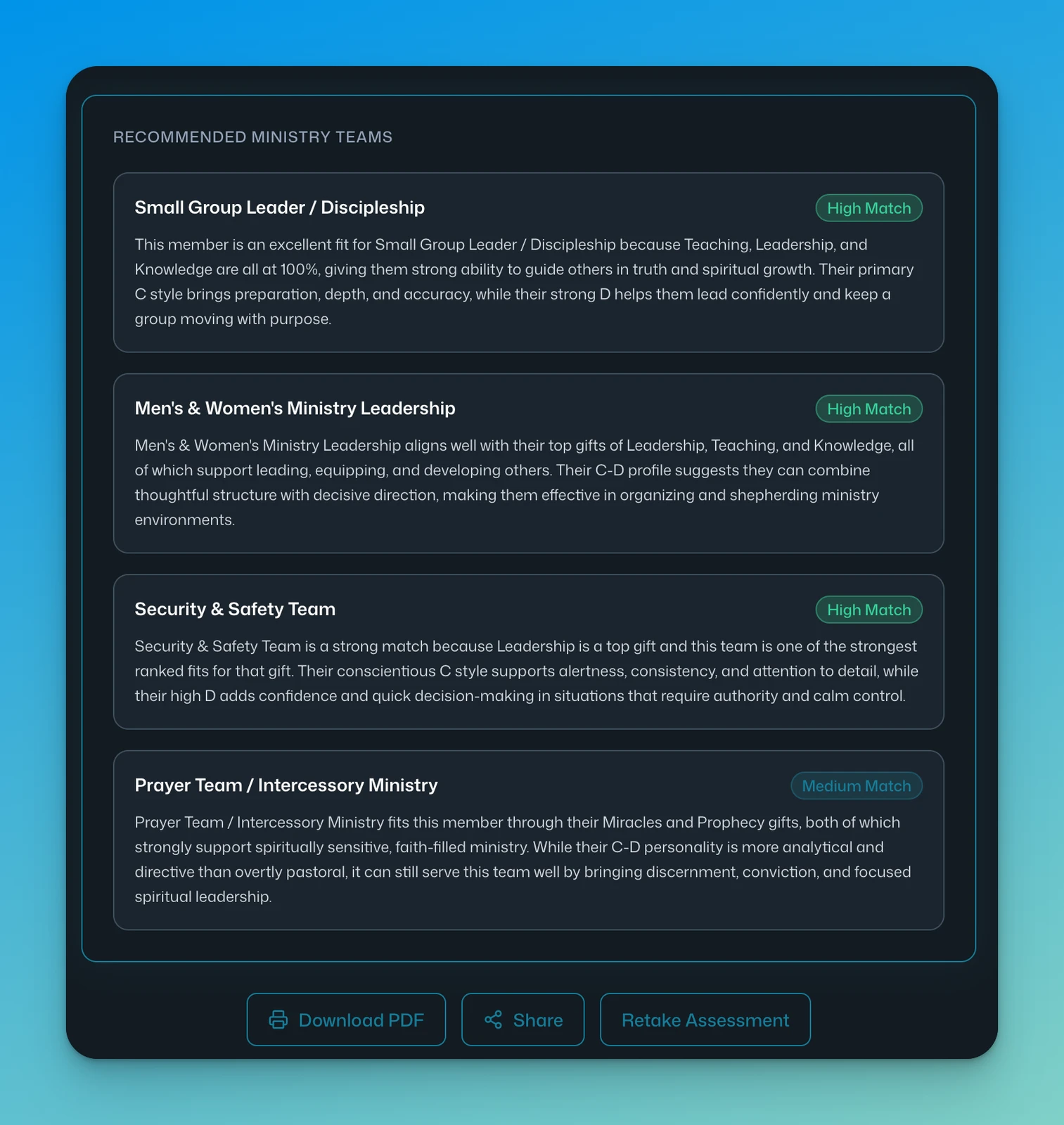
Stop assigning by availability and start assigning by gifting. Assess your people — actually assess them, don’t guess — and align the seats to the wiring. The assessment we use is 112 questions across 24 spiritual gifts and four DISC dimensions, about 20 minutes on a phone, and it matches each person to the actual named teams on your roster — ranked High Match and Medium Match, with the reasons why. Seat-by-wiring stops being a judgment call. This is the least spiritual-sounding step and the one that unlocks the most.
Step 4 — Point 90 days of focus at the barrier
Once you know your biggest constraint, refuse to nibble at it. Turn it into one or two 90-day objectives — specific, measurable, one owner, one deadline — and back each with weekly actions you control: interviews conducted, leaders trained, follow-ups made within 48 hours. Review them every single week. Barriers don’t fall to good intentions spread across a year; they fall to concentrated focus applied for a quarter at a time.
Step 5 — Learn the whole system in 75 minutes
These four steps come out of the operating system I’ve run at Hope City and in every church I coach. I taught it start to finish in Momentum — my free 8-session course: strategic clarity, annual priorities, 90-day ITAs, alignment, lead measures, weekly execution. If your church is at a ceiling, this is the most useful 75 minutes I can give you.
Book a 20-minute demo and we’ll run the spiritual gifts + DISC assessment on your whole staff at no cost. You’ll see in an afternoon who’s in the wrong seat — and who’s ready for a bigger one.
The ceiling isn’t your calling, your preaching, or your people. It’s the structure — and structure is fixable. Find the leaks, build for what’s next, move the seats, and focus for 90 days. That’s how ceilings become floors.
— Your church doesn’t need more. It needs momentum.
Momentum
The operating system behind Hope City — strategic clarity, annual priorities, 90-day ITAs, lead measures, and the weekly execution rhythm that turns vision into what actually happens.
 ▶
▶+ 4 more sessions — all free
Get the free course
Instant access — every lesson, free forever. No card, no catch.

“If you’re a pastor, you need to know about PastorCenter.”
Josh Howerton · Lead Pastor, Lakepointe Church